
Divorce Waiting Period by State: How Long Do You Have to Wait to Get Divorced?
Divorce does not happen on the same timeline in every state. Some states allow a divorce to move forward relatively quickly, while others require a waiting period before the divorce can be finalized.
That waiting period can be confusing because it does not always begin when one spouse decides the marriage is over. In many states, the clock may begin when divorce papers are filed, when the other spouse is served, or after another required step in the legal process.
Because divorce laws vary from state to state, it is important to understand the rules where your case is filed.
What Is a Divorce Waiting Period?
A divorce waiting period is the minimum amount of time that must pass before a court can finalize a divorce.
This does not always mean your divorce will be complete as soon as the waiting period ends. The waiting period is only one part of the process. Property division, parenting plans, support issues, court availability, and unresolved disagreements can all affect how long the divorce actually takes.
In an amicable divorce, the process may move more smoothly because both parties are working toward resolution rather than conflict. But even in a cooperative divorce, state law may still require a minimum waiting period.
When Does the Waiting Period Start?
The starting point depends on the state.
In some states, the waiting period may begin when the divorce petition is filed. In others, it may begin when the other spouse is formally served with divorce papers. Some states calculate the waiting period differently depending on whether the divorce is contested, uncontested, fault-based, or no-fault.
This is why two people in different states may have very different timelines, even if both divorces are amicable.
Do Divorce Waiting Periods Vary by State?
Yes. Divorce waiting periods vary widely across the United States.
For example, some states have little or no mandatory waiting period, while others require weeks or months before a divorce can be finalized. California, for example, is commonly known for having a six-month waiting period. Other states may have shorter waiting periods, such as 30, 60, or 90 days, depending on the circumstances.
The important point is that there is no single national rule. Divorce is handled at the state level, so the answer depends on where the divorce is filed.
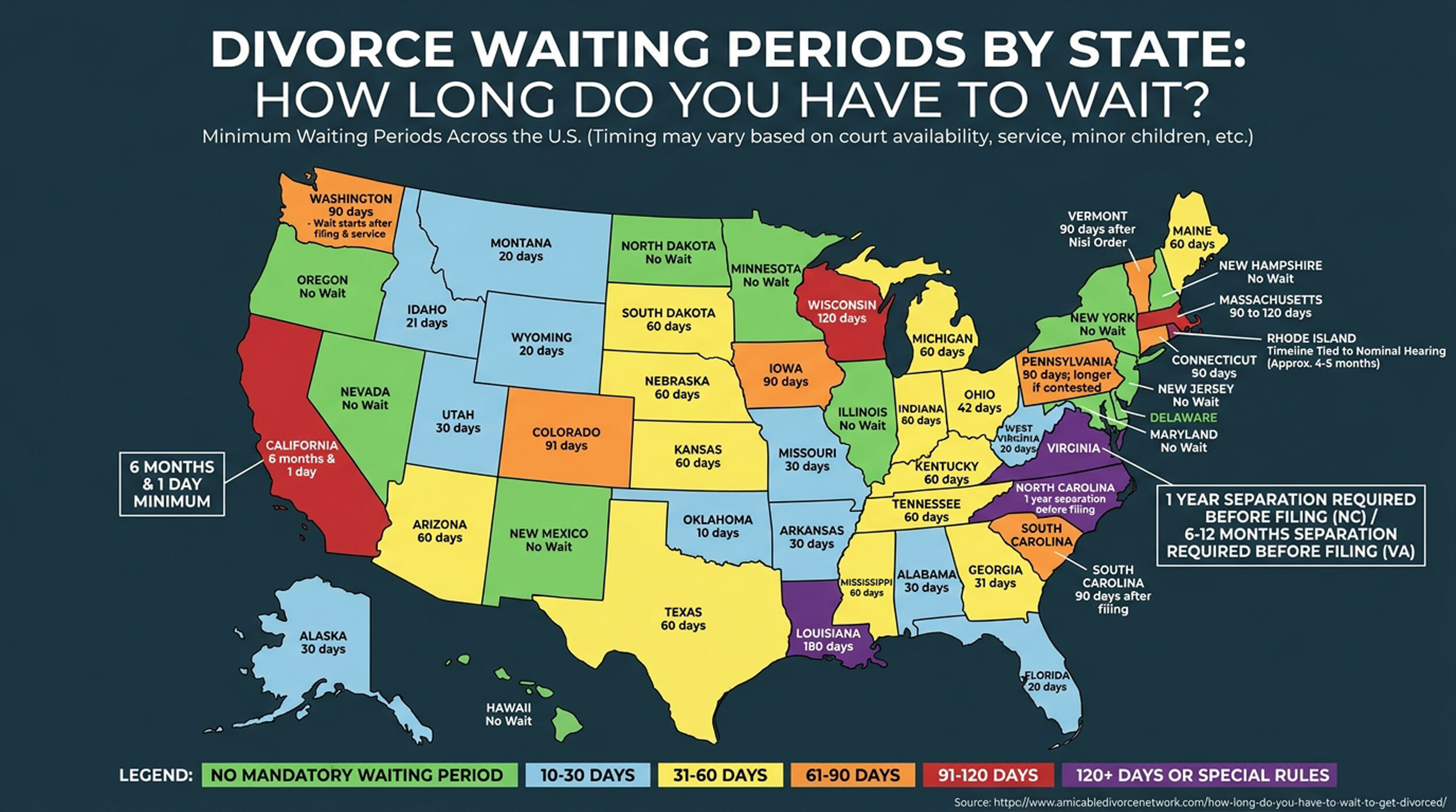
Below is a general state-by-state overview of divorce waiting periods to help you understand how timelines can vary depending on where your divorce is filed.
Divorce waiting periods vary widely across the United States. Some states allow a divorce to be finalized quickly, while others require a minimum waiting period or separation period before the divorce can be completed. This table is a general overview only. Divorce laws can change, and local rules or case-specific circumstances may affect your timeline.
| State | Minimum Waiting Period | When the Clock Usually Starts | Notes |
|---|---|---|---|
| Alabama | 30 days | After filing | Actual timing may depend on court availability, service, and case complexity. |
| Alaska | 30 days | After filing | Actual timing may depend on court availability, service, and case complexity. |
| Arizona | 60 days | After service of process | The waiting period generally begins after the other spouse is served. |
| Arkansas | 30 days | After filing | Actual timing may depend on court availability, service, and case complexity. |
| California | 6 months and 1 day | After service or response, whichever is later | California has one of the longer minimum divorce waiting periods. |
| Colorado | 91 days | After service or response | The timeline may depend on when service or response occurs. |
| Connecticut | 90 days | After the return date | Connecticut uses a return-date-based timeline. |
| Delaware | No post-filing waiting period listed | N/A | A separate separation requirement may apply. |
| Florida | 20 days | After filing | Actual finalization may take longer depending on the court and case details. |
| Georgia | 31 days | After service of process | The waiting period generally begins after the defendant is served. |
| Hawaii | No mandatory waiting period listed | N/A | Processing time may still depend on court procedures and case details. |
| Idaho | 21 days | After service of process | The waiting period may be longer when minor children are involved. |
| Illinois | No mandatory waiting period listed | N/A | Processing time may still depend on court procedures and case details. |
| Indiana | 60 days | After filing | Actual timing may depend on court availability and case complexity. |
| Iowa | 90 days | After service of process | The waiting period generally begins after the other spouse is served. |
| Kansas | 60 days | After filing | Actual timing may depend on court availability and case complexity. |
| Kentucky | 60 days | After filing | Additional separation or residency rules may affect timing. |
| Louisiana | 180 days | After service of process | The waiting period may be longer when minor children are involved. |
| Maine | 60 days | After service of process | The waiting period generally begins after the other spouse is served. |
| Maryland | No mandatory waiting period listed | N/A | Processing time may still depend on court procedures and case details. |
| Massachusetts | 90 to 120 days | After Judgment Nisi | The timeline can vary depending on the type of divorce filing. |
| Michigan | 60 days | After filing | The waiting period may be longer when minor children are involved. |
| Minnesota | No mandatory waiting period listed | N/A | Processing time may still depend on court procedures and case details. |
| Mississippi | 60 days | After filing | Actual timing may depend on court availability and case complexity. |
| Missouri | 30 days | After filing | Actual timing may depend on court availability and case complexity. |
| Montana | 20 days | After service of process | Actual timing may depend on court availability and case complexity. |
| Nebraska | 60 days | After service of process | The waiting period generally begins after the other spouse is served. |
| Nevada | No mandatory waiting period listed | N/A | Processing time may still depend on court procedures and case details. |
| New Hampshire | No mandatory waiting period listed | N/A | Processing time may still depend on court procedures and case details. |
| New Jersey | No mandatory waiting period listed | N/A | Processing time may still depend on court procedures and case details. |
| New Mexico | No mandatory waiting period listed | N/A | Processing time may still depend on court procedures and case details. |
| New York | No mandatory waiting period listed | N/A | Processing time may still depend on the court, paperwork, and case details. |
| North Carolina | 1 year separation before filing | Before filing | North Carolina generally requires a full year of separation before filing for absolute divorce. |
| North Dakota | No mandatory waiting period listed | N/A | Processing time may still depend on court procedures and case details. |
| Ohio | 42 days | After service of process | The waiting period generally begins after the other spouse is served. |
| Oklahoma | 10 days | After filing | The waiting period may be longer when minor children are involved. |
| Oregon | No mandatory waiting period listed | N/A | Processing time may still depend on court procedures and case details. |
| Pennsylvania | 90 days; longer if contested | After service of process | Contested cases may involve a longer separation period or additional requirements. |
| Rhode Island | Approximately 4 to 5 months | After nominal hearing | The timeline is tied to the nominal hearing process. |
| South Carolina | 90 days after filing | After filing | A one-year separation requirement may also apply for no-fault divorce. |
| South Dakota | 60 days | After service of process | The waiting period generally begins after the other spouse is served. |
| Tennessee | 60 days | After filing | The waiting period may be longer when minor children are involved. |
| Texas | 60 days | After filing | Actual timing may depend on court availability and case complexity. |
| Utah | 30 days | After filing | Actual timing may depend on court availability and case complexity. |
| Vermont | 90 days after Nisi Order | After Nisi Order | A separation period may also apply before finalization. |
| Virginia | 6 to 12 months separation before filing | Before filing | Six months may apply in some uncontested cases; one year may apply in others. |
| Washington | 90 days | After filing and service | The clock generally requires both filing and service to have occurred. |
| West Virginia | 20 days | After service of process | The waiting period generally begins after the other spouse is served. |
| Wisconsin | 120 days | After service of process | The waiting period generally begins after the other spouse is served. |
| Wyoming | 20 days | After filing | Actual timing may depend on court availability and case complexity. |
Note: The minimum waiting period is not the same as the full divorce timeline. Service, court availability, contested issues, parenting matters, and local procedures may all affect how long a divorce actually takes.
If you are unsure how the waiting period applies in your state, search our member directory to connect with an Amicable Divorce Network professional who can help you understand your options.
Why the Waiting Period Matters
The waiting period can affect more than just the emotional timeline of divorce. It may also matter for practical and financial reasons.
For example, some people want to understand whether they can complete their divorce before the end of the year for tax, insurance, retirement, or personal planning reasons. Others may need to know how the timeline affects parenting arrangements, relocation plans, or future remarriage.
If timing is important, it is best to speak with a divorce professional in your state as early as possible.
Why Some Divorces Take Longer Than the Minimum Waiting Period
Even if your state has a short waiting period, your divorce may still take longer.
Common reasons include:
- Disagreements about parenting time or custody
- Property or debt division issues
- Spousal support questions
- Delays in exchanging financial information
- Court scheduling delays
- One party not responding
- Complicated business, retirement, or real estate matters
An amicable process can help reduce unnecessary conflict, but the legal timeline still depends on the facts of the case and the rules in your state.
How to Find the Divorce Waiting Period in Your State
The best way to understand your timeline is to speak with a qualified divorce professional who works in your state.
An Amicable Divorce Network professional can help you understand your options, avoid unnecessary conflict, and move through the process with more clarity.
If you are unsure how long you have to wait to get divorced in your state, search our member directory to connect with a professional who can answer questions based on your location and situation.
Final Thoughts
Divorce waiting periods can be frustrating, especially when both parties are ready to move forward. But understanding the timeline early can help you plan more realistically and avoid surprises.
Every state is different, and every divorce has its own circumstances. Before making decisions based on timing, speak with a divorce professional in your state who can explain the rules that apply to you.
If you are considering divorce and want help finding the right professional, visit Divorce Amicably, a resource created to help individuals and families navigate divorce with less conflict.